
Tintin or the Difficult Brush-Stroke: an Eventful Journey to Mainstream Cinema
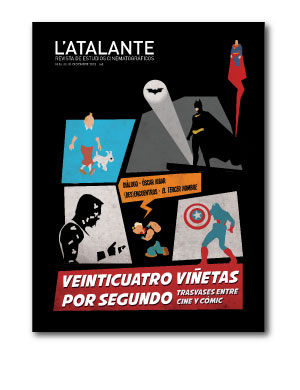
Published 2013-07-01
Keywords
- Tintin,
- Hergé,
- film and TV adaptation,
- comic,
- Steven Spielberg
- Peter Jackson,
- animation,
- motion capture ...More
How to Cite
Abstract
Tintin’s success as one of the great figures of the twentieth century comics is mainly due to two reasons. One, its constant metamorphosis: from a character with fascist and colonialist connotations to an adventurer that banners humanism and justice. Two, the simple but effective style of Hergé, characterized by a simplification of the cartoons to the basic elements of the story, as well as an intuition to express movement and action. These key factors have marked the evolution of Tintin during his adventures and have also conditioned the success or failure of its adaptations to television and film. This article analyses this evolution, as well as the dialogue between the graphic image and the moving image, that have culminated in The Adventures of Tintin: Secret of the Unicorn. This US blockbuster directed by Steven Spielberg adapts the adventures of the Belgian reporter to motion capture animation, a technique whose expressive results are in conflict with the shapes proposed by Hergé.
Downloads
References
— (2009). The Metamorphoses of Tintin: or Tintin for Adults. Palo Alto: Stanford University Press.
COSTA, Jordi (2011). Las aventuras de Tintín: El secreto del Unicornio. Fotogramas.es. Recuperado de http://www.fotogramas.es/Peliculas/Las-aventuras-de-Tintin-El-secreto-del-unicornio/Critica.
— (2011b) Tintín en los universos paralelos (del cine). El País Tentaciones. Recuperado de: http://tentaciones.elpais.com/2011/10/tintin-costa.html.
GAUMER, Patrick, y MOLITERNI, Claude (1996). Diccionario del Cómic. Barcelona: Larousse Planeta.
GASCA, Luis, y GUBERN, Román (2011). El discurso del cómic. Madrid: Cátedra.
GIROUX, Renée-Héloïse y Hébert, François (1993). ¿Eres tintinólogo? Barcelona: Editorial Juventud.
HANDY, Bruce (2009). Tintibulation. The New York Times. Recuperado de http://www.nytimes.com/2009/12/27/books/review/Handy-t.html?pagewanted=all.
HERGÉ (1972). El asunto Tornasol. Barcelona: Editorial Juventud.
— (1979). El tesoro de Rackham el Rojo. Barcelona: Editorial Juventud.
— (1982). El cangrejo de las pinzas de oro. Barcelona: Editorial Juventud.
— (1983). Los cigarros del faraón. Barcelona: Editorial Juventud.
— (1987). La estrella misteriosa. Barcelona: Editorial Juventud.
— (1988). Tintín en el Tíbet. Barcelona: Editorial Juventud.
— (1988). Las siete bolas de cristal. Barcelona: Editorial Juventud.
— (1989). El secreto del Unicornio. Barcelona: Editorial Juventud.
— (1989). La isla negra. Editorial Juventud: Barcelona.
— (1990). Aterrizaje en la Luna. Barcelona: Editorial Juventud.
— (1992). Objetivo: la Luna. Barcelona: Editorial Juventud.
— (1992). Tintín en el país de los Soviets. Barcelona: Editorial Juventud.
— (1993). El loto azul. Barcelona: Editorial Juventud.
— (1993). Tintín en el Congo. Barcelona: Editorial Juventud.
— (1995). Tintín y los pícaros. Barcelona: Editorial Juventud.
— (1999). El templo del sol. Barcelona: Editorial Juventud.
— (2004). La oreja rota. Barcelona: Editorial Juventud.
MERCIER, Frédéric (2011). Tintin et les mystères de la adaptation. TCM. Recuperado de http://tcmcinema.fr/2011/10/19/tintin-et-les-mysteres-de-ladaptation/.
MUÑOZ, Almudena (2008). El misterio del Toisón de Oro: A Tintín se le suben los colores de la realidad. LaButaca.net. Recuperado de http://reportajes.labutaca.net/el-misterio-del-toison-de-oro-a-tintin-se-le-suben-los-colores-de-la-realidad/.
ORTOLI, Sven y SERRES, Michel (2011). Tintin au pays des philosophes. París: Philosophie Magazine.
SERRES, Michel (2011). Serres : «Hergé est le Jules Verne du XXe siècle». Le JDD. Recuperado de http://www.lejdd.fr/Culture/Livres/Actualite/Le-philosophe-Michel-Serres-evoque-Tintin-et-Herge-interview-411069.
TERRASA, Rodrigo (2011). Cuando Tintín y Haddock bailaron flamenco en Valencia. ElMundo.es C. Valenciana. Recuperado de http://www.elmundo.es/elmundo/2011/10/24/valencia/1319462351.html.