
Published 2024-01-31
Keywords
- Film,
- Czechoslovak New Wave,
- Female gymnastic,
- Representation of women,
- Věra Chytilová
How to Cite
Copyright (c) 2024 L'Atalante. Journal of film studies

This work is licensed under a Creative Commons Attribution-NonCommercial-NoDerivatives 4.0 International License.
Abstract
The female sporting body is a concept defined by Tatiana S
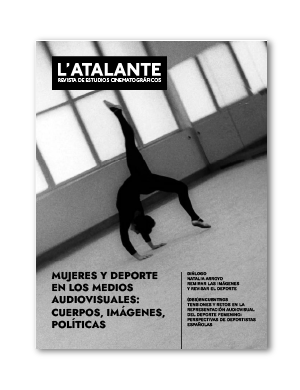
The female sporting body is a concept defined by Tatiana Sentamans as a first step away from the patriarchal conception of the public sphere as masculine and the private sphere as feminine. By making changes to their bodies that depart from the traditional canon of female beauty and entering public spaces traditionally deemed male, female athletes challenge this logic. In Something Different (O něčem jiném, 1963), Věra Chytilová, a key figure in the Czechoslovak New Wave, plays with blurring the line between fiction and reality by combining what could be a documentary about the elite gymnast Eva Bosaková with a fictional story about a housewife named Věra. What at first appears to be an opposition between the two very different lives portrayed alternately on screen turns out to be a comparison of two woman who have more in common than expected. Taking into account the sociopolitical context of Czechoslovakia in the 1960s, this article aims to explore these similarities and to identify how Chytilová reflects on and reconstructs the notion of the female sporting body, placing it in opposition against—and on a par with—the canonical body of the traditional housewife.
entamans as a first approach to breaking with the patriarchal conception of the public sphere as masculine and the private sphere as feminine. Through changes in their bodies that depart from the traditional female canon of beauty and the occupation of traditionally male public spaces, female athletes challenge this logic. In Something Different (O něčem jiném, 1963) by the key filmmaker of the Czechoslovak New Wave, Věra Chytilová, the director plays with the blurring between fiction and reality and combines what could be a documentary about the elite gymnast Eva Bosaková with a fictional story about a housewife named Věra. What at first appears to be an opposition between the two very different lives interspersed on the screen turns out to be a simile, as the two protagonists have more in common than it seemed. This essay aims to look at these similarities and to see how Chytilová reflects and reconstructs the notion of the female sporting body, pitting it against - and equating it with - the canonical body of the traditional housewife, considering the socio-political context of Czechoslovakia in the 1960s.
Downloads
References
- Barker-Ruchti, N. (2009). Ballerinas and Pixies: A Genealogy of the Changing Female Gymnastics Body, The International Journal of the History of Sport, 26(1), 45-62. https://doi.org/10.1080/09523360802500089
- Čulík, J. (2018). In search of authenticity: Věra Chytilová’s films from two eras. Studies in Eastern European Cinema, 9(3), 198-218. https://doi.org/10.1080/2040350X.2018.1469197
- Foucault, M. (1978). Discipline and Punish: The Birth of the Prison. New York: Random House.
- Hames, P. (2009). Czech and Slovak Cinema: Theme and Tradition. Edinburgh: Edinburgh University Press ltd.
- Hames, P. (2005). The Czechoslovak New Wave. 2nd ed. New York: Wallflower Press.
- Iordanova, D. (2004). Cinema of the Other Europe: The Industry and Artistry of East Central European film. New York: Wallflower Press.
- Kaplan, E. A. (1990). Sex, Work and Motherhood: The Impossible Triangle. The Journal of Sex Research, 27(3), 409–425. http://www.jstor.org/stable/3812811
- Klein, M. (1980). Körperlichkeit bei Spitzensportlerinnen. Sportpädagogik, 4(4), 4-21.
- Kollontai, A. (1977). Selected Writings. New York: Norton.
- Lafon, L. (2015). La pequeña comunista que no sonreía nunca. Barcelona: Anagrama.
- Mazierska, E., Mroz, M., & Ostrowska Elżbieta. (2018). The Cinematic Bodies of Eastern Europe and Russia: Between Pain and Pleasure. Edinburgh: Edinburgh University Press.
- Pilát, T. (2010). Věra Chytilová zblízka. Prague: XYZ.
- Sentamans, T. (2010). Amazonas mecánicas: engranajes visuales, políticos y culturales. Madrid: Ministerio de Cultura.
- Sywenky, I. (2016). Discourses of the Maternal in the Cinema of Eastern Europe. In Sayed, A. (ed.), Screening Motherhood in Contemporary World Cinema. Bradford: Demeter Press.
- Valle Corpas, I. (2021) Between Home and Flight: Interior Space, Time and Desire in the Films of Chantal Akerman, Journal of Aesthetics & Culture, 13(1), https://doi.org/10.1080/20004214.2021.1914969
- Wagnerová, A. (2016). Women as the Object and Subject of the Socialist Form of Women’s Emancipation. Czech Feminisms: Perspectives on Gender in East Central Europe. Bloomington: Indiana University Press, 118.
- Zbyněk, V. (2021). Autorka neklidu Věra Chytilová očima české filmové kritiky. Brno: Moravská Zemská Knihovna v Brně.